I Love Geography

I Love Geography

Tuesday, 6 December 2011

According to the latest prediction, Britain's population will exceed 70 million by 2031. The country will be a very different place by then


The causes of the relentless increase over the recent centuries in the UK's population – now projected to pass 70 million within 25 years – are many and varied.
They range from medical advances and growing individual prosperity to greater life expectancy and the waves of immigration.
The UK is now home to almost 61 million people, some 20 million more than a century ago and 50 million more than 1801, with the population growing in 99 of the past 100 years. Predictions that the number would stabilise at between 55 million and 60 million have been torn up and population growth is accelerating again, pushing the issue towards the top of the political agenda.
The rate of increase has even taken Whitehall's statisticians by surprise, with the Office for National Statistics (ONS) yesterday revising its population projections upwards. On current trends, the ONS now forecasts the numbers in Britain will grow to 62.8 million in 2011, 65 million in 2016, 67.2 million in 2021, 69.3 million in 2026 and 71.1 million in 2031, 78.6 million in 2051 and 85.3 million in 2081. That means that the UK's population is now rising by about 400,000 a year.
The face of Britain was transformed in the 19th century by the massive movements of people in the Industrial Revolution, and it will continue changing. Pressure for housing will mean swathes of countryside disappearing under concrete.
The country's demographic make-up is also altering rapidly, with Leicester set to become the first city where whites are in a minority by the end of next decade.
Just over half the population growth is caused by increases in family size – the average woman now has 1.84 children – and by greater life expectancy. Boys and girls born today will live an average of 77.2 years and 81.5 years respectively; that is forecast to rise to 82.7 years and 86.2 years for those born in 2031.
The rest of the growth has been driven by higher-than-expected levels of migration in recent years, with a net annual influx of about 190,000 compared with previous estimates of 145,000. Population increases are predicted for the whole of the UK, although they are expected to be smaller in Scotland than elsewhere.
The figures also confirm that a demographic time bomb is ticking, with the number of people over the state pension age – 11.3 million, and projected to reach 12.2 million in 2010 – for the first time exceeding the number of children.
The ONS stressed yesterday that, rather than making firm forecasts, its projections were based on current trends and that they became less reliable the further they looked into the future. Previous statisticians have got it spectacularly wrong when peering into the crystal ball. When the experts of the 1960s extrapolated the effects of the post-war "baby boom", they concluded that the population would be 75 million by 2007.
But Liam Byrne, the Immigration minister, said: "These projections show what could happen unless we take action now."
He said they underlined the need for "swift and sweeping" changes to the immigration system in the pipeline, including the introduction of an Australian-style points based system for migrants from outside the European Union.
The Tories are calling for annual limits on the numbers of new arrivals admitted into the country. David Davis, the shadow Home Secretary, said: "The shocking acceleration in the rate of population growth makes it more urgent than ever that the Government should introduce a properly controlled immigration system." Rosamund McDougall, of the Optimum Population Trust think-tank, said: "There is no parallel in our history for population growth of this magnitude. It will blow a massive hole in any national climate change strategy, impose huge strains on our infrastructure and environment, seriously damage quality of life and make Britain one of the most crowded and stressful places in the world."

Wednesday, 9 November 2011

Monday, 31 October 2011

World reaches 7 billion (cat populace not included)


Today, the world's seven billionth person has been born. It is impossible to say exactly where the seven billionth person on the planet has been born or who they are.
So the United Nations have chosen several newborn babies across the world to symbolically represent the global population milestone, including two baby girls Nargis and Danica who were born in India and the Philippines, respectively.
However, the stark reality is that if a baby girl is born in the developing world, her future is set to be far from rosy.
According to a recent report from the United Nations Children’s Fund (UNICEF) there is a widening gap between boys and girls in these regions of the world.
While they receive the same care and opportunities during early childhood, as they reach adolescence the anomalies in terms of health or education become marked.
“While there is little difference between boys and girls in early childhood with respect to nutrition, health, education and other basic indicators, differences by gender appear increasingly more pronounced during adolescence and young adulthood,” said UNICEF deputy executive director Geeta Rao Gupta.
If the seven billionth child born was a girl in the developed world, for instance in Europe, Japan or the United States, once she becomes a teenager she is likely to receive many of the same opportunities as her male peers.
Her education, health and career prospects may even exceed those of her male counterparts.
But if she is born in a region defined as ‘developing’ she is significantly more likely to be married as a child, less likely to be literate than young men in her country and, shockingly, should she be born in sub-Saharan Africa, is as many as four times more likely to contract HIV/AIDS than boys her age.
A World Bank working paper examined the real economic impact of excluding girls from learning or work opportunities.
For instance, just one teenage mother in India can lose $100,000 (£62,052) in potential income over her lifetime, while a single girl in Ethiopia who has dropped out of school can expect to lose the equivalent of two months’ average pay per year.
The financial impacts on the national economies is bigger still: the cost to India of the 3.8 million girls having children at the ages of 15 to 19 is $7.6 billion a year (£4.7 billion) – enough to fill every single car in the US with a full tank of petrol 100 times.
The denial of education to 4.5 million girls in Ethiopia costs the country $582 million (£361 million) a year.
So beyond the headlines about the seven billionth birth – which will come 12 years after the six billionth, a baby boy in Sarajevo – UNICEF chiefs are urging developing countries to improve the education prospects of their female citizens.
Increasing the availability of good and long-term schooling for girls will have a ‘ripple effect’ and help to break the cycle of poverty in those regions.
“Closing gender gaps in all stages of childhood and eliminating gender discrimination – whether against girls or boys – are fundamental to inclusive and sustained progress for countries around the world,” said Rao Gupta.
“In addition to the harmful and often tragic effects of gender inequalities on children themselves, the kinds of persistent inequalities that we continue to see… are major barriers to the efforts of many nations to move out of long-term poverty and achieve their development aspirations.”

Sunday, 23 October 2011

Guess I must have taken this by accident
when I was asleep during the talk

Guess who parked the one on the left...

Don't worry, we left the window slightly open

Luckily Bealing was equipped for a cave
environment, having TM07 Flash as his only move

We were going to look round for
an hour. Ended up as ten minutes.

A generic building. Could be Newton for
all I know.

Remember, you're not in a traffic jam,
you are a traffic jam

Ironically the only department that gets lost on trips...


Can you spot?:
A: The happy geogrpaher?
B. The sad geographer?
C. Wally?
D. Tom Morrish skiving?

Monday, 10 October 2011

Sunday, 14 August 2011

One-child policy a surprising boon for China girls


In 1978, women made up only 24.2 percent of the student population at Chinese colleges and universities. By 2009, nearly half of China's full-time undergraduates were women and 47 percent of graduate students were female, according to the National Bureau of Statistics.
In India, by comparison, women make up 37.6 percent of those enrolled at institutes of higher education, according to government statistics.
Since 1979, China's family planning rules have barred nearly all urban families from having a second child in a bid to stem population growth. With no male heir competing for resources, parents have spent more on their daughters' education and well-being, a groundbreaking shift after centuries of discrimination.
"They've basically gotten everything that used to only go to the boys," said Vanessa Fong, a Harvard University professor and expert on China's family planning policy.
Wang and many of her female classmates grew up with tutors and allowances, after-school classes and laptop computers. Though she is just one generation off the farm, she carries an iPad and a debit card, and shops for the latest fashions online.
Her purchases arrive at Tsinghua, where Wang's all-girls dorm used to be jokingly called a "Panda House," because women were so rarely seen on campus. They now make up a third of the student body, up from one-fifth a decade ago.
"In the past, girls were raised to be good wives and mothers," Fong said. "They were going to marry out anyway, so it wasn't a big deal if they didn't want to study."
Not so anymore. Fong says today's urban Chinese parents "perceive their daughters as the family's sole hope for the future," and try to help them to outperform their classmates, regardless of gender.
Some demographers argue that China's fertility rate would have fallen sharply even without the one-child policy because economic growth tends to reduce family size. In that scenario, Chinese girls may have gotten more access to education anyway, though the gains may have been more gradual.
Crediting the one-child policy with improving the lives of women is jarring, given its history and how it's harmed women in other ways. Facing pressure to stay under population quotas, overzealous family planning officials have resorted to forced sterilizations and late-term abortions, sometimes within weeks of delivery, although such practices are illegal.
The birth limits are also often criticized for encouraging sex-selective abortions in a son-favoring society. Chinese traditionally prefer boys because they carry on the family name and are considered better earners.
With the arrival of sonogram technology in the 1980's, some families no longer merely hoped for a boy, they were able to engineer a male heir by terminating pregnancies when the fetus was a girl.
"It is gendercide," said Therese Hesketh, a University College London professor who has studied China's skewed sex ratio. "I don't understand why China doesn't just really penalize people who've had sex-selective abortions and the people who do them. The law exists but nobody enforces it."
To combat the problem, China allows families in rural areas, where son preference is strongest, to have a second child if their first is a girl. The government has also launched education campaigns promoting girls and gives cash subsidies to rural families with daughters.
Still, 43 million girls have "disappeared" in China due to gender-selective abortion as well as neglect and inadequate access to health care and nutrition, the United Nations estimated in a report last year.
Yin Yin Nwe, UNICEF's representative to China, puts it bluntly: The one-child policy brings many benefits for girls "but they have to be born first."
Wang's birth in the spring of 1992 triggered a family rift that persists to this day. She was a disappointment to her father's parents, who already had one granddaughter from their eldest son. They had hoped for a boy.
"Everyone around us had this attitude that boys were valuable, girls were less," Gao Mingxiang, Wang's paternal grandmother, said by way of explanation — but not apology.
Small and stooped, Gao perched on the edge of her farmhouse "kang," a heated brick platform that in northern Chinese homes serves as couch, bed and work area. She wore three sweaters, quilted pants and slippers.
Her granddaughter, tall and graceful and dressed in Ugg boots and a sparkly blue top, sat next to her listening, a sour expression on her face. She wasn't shy about showing her lingering bitterness or her eagerness to leave. She agreed to the visit to please her father but refused to stay overnight — despite a four-hour drive each way.
Fong, the Harvard researcher, says that many Chinese households are like this these days: a microcosm of third world and first world cultures clashing. The gulf between Wang and her grandmother seems particularly vast.
The 77-year-old Gao grew up in Yixian, a poor corn- and wheat-growing county in southern Liaoning province. At 20, she moved less than a mile (about a kilometer) to her new husband's house. She had three children and never dared to dream what life was like outside the village. She remembers rain fell in the living room and a cherished pig was sold, because there wasn't enough money for repairs or feed.
She relied on her daughter to help around the house so her two sons could study.
"Our kids understood," said Gao, her gray hair pinned back with a bobby pin, her skin chapped by weather, work and age. "All families around here were like that."
But Wang's mother, Zheng Hong, did not understand. She grew up 300 kilometers (185 miles) away in the steel-factory town of Benxi with two elder sisters and went to vocational college for manufacturing. She lowers her voice to a whisper as she recalls the sting of her in-law's rejection when her daughter was born.
"I sort of limited my contact with them after that," Zheng said. "I remember feeling very angry and wronged by them. I decided then that I was going to raise my daughter to be even more outstanding than the boys."
They named her Qihua, a pairing of the characters for chess and art — a constant reminder of her parents' hope that she be both clever and artistic.
From the age of six, Wang was pushed hard, beginning with pingpong lessons. Competitions were coed, and she beat boys and girls alike, she said. She also learned classical piano and Chinese flute, practiced swimming and ice skating and had tutors for Chinese, English and math. During summer vacations, she competed in English speech contests and started using the name Mia.
In high school, Wang had cram sessions for China's college entrance exam that lasted until 10 p.m. Her mother delivered dinners to her at school. She routinely woke up at 6 a.m. to study before class.
She had status and expectations her mother and grandmother never knew, a double-edged sword of pampering and pressure.
If she'd had a sibling or even the possibility of a sibling one day, the stakes might not have been so high, her studies not so intense.
Beijing-based population expert Yang Juhua has studied enrollment figures and family size and determined that single children in China tend to be the best educated, while those with elder brothers get shortchanged. She was able to make comparisons because China has many loopholes to the one-child rule, including a few cities that have experimented with a two-child policy for decades.
"Definitely single children are better off, particularly girls," said Yang, who works at the Center for Population and Development Studies at Renmin University. "If the girl has a brother then she will be disadvantaged. ... If a family has financial constraints, it's more likely that the educational input will go to the sons."
While her research shows clearly that it's better, education-wise, for girls to be single children, she favors allowing everyone two kids.
"I do think the (one-child) policy has improved female well-being to a great extent, but most people want two children so their children can have somebody to play with while they're growing up," said Yang, who herself has a college-age daughter.
Ideally, she said, China should relax the policy while also investing more in education so that fewer families will be forced to choose which child to favor when it comes to schooling.
While strides have been made in reaching gender parity in education, other inequalities remain. Women remain woefully underrepresented in government, have higher suicide rates than males, often face domestic violence and workplace discrimination and by law must retire at a younger age than men.
It remains to be seen whether the new generation of degree-wielding women can alter the balance outside the classroom.
Some, like Wang, are already changing perceptions about what women can achieve. When she dropped by her grandmother's house this spring, the local village chief came by to see her. She was a local celebrity: the first village descendent in memory to make it into Tsinghua University.
"Women today, they can go out and do anything," her grandmother said. "They can do big things."

Saturday, 16 July 2011

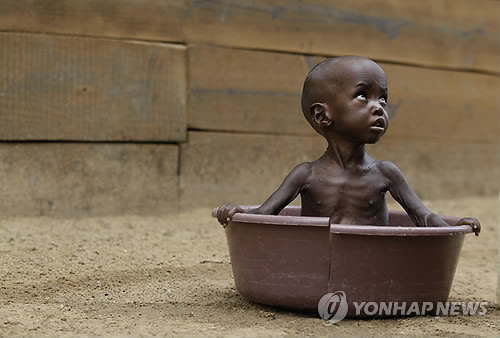
East African drought

The plight of millions of people left hungry by a harsh drought across the Horn of Africa is set to worsen, with the rains not expected soon and harvests months away, a top UN official warned Saturday.
Scanty or failed rainfall in the region over the past two years has already forced thousands of Somalis to flee their country and ruined the livelihoods of millions in parts of Kenya, Ethiopia and Djibouti.
Kenya East Africa Drought"We are possibly seeing a perfect storm in the coming months.... We are going to do everything we can to ameliorate it," UNICEF director Anthony Lake told AFP as he visited Kenya's drought-hit Turkana region.
"We are scaling up in every way we can.... It is very bad now. There will be no major harvests until some time next year. The next six months are going to be very tough," he added.
Turkana is one of Kenya's badly affected regions where malnutrition rates have risen to 37 percent, up from 15 percent in 2010, according to the aid organisation Oxfam.
The drought has also wiped out almost all the cattle, the mainstay of Turkana people, with the remaining emaciated animals driven elsewhere in search of pasture.
"The animals have all died. I am old, I cannot go to town to find work, I cannot fish, so I am just waiting," said 70-year-old Loruman Lobuin, sitting under a tree, his skinny body partly exposed under his traditional shawl.
A nurse in Lodwar, Turkana's main town, said the number of children admitted suffering malnutrition had doubled since last year.
"Many children arrive already malnourished and weak and some are irritable, but they are the lucky ones who make it here."
Lake noted that the drought was not only endangering lives, but "a way of life is being threatened also," referring to the nomadic tradition of the Turkana people.
"I have seen heart-wrenching things and oddly enough, admirable things. I cannot admire enough people living under circumstances like these," said the UNICEF chief after visiting Turkana villages.
Western countries and other donors have pledged millions of dollars in aid for the drought victims but Lake said more still needed to be done.
Britain promised 52 million pounds (59 million euro, 73 million dollars) in emergency aid, in a statement Saturday from International Development Secretary Andrew Mitchell.
"The situation is getting worse and is particularly devastating in Somalia, where families already have to cope with living in one of the most insecure countries in the world," Mitchell said.
He called for doing "more to help not only refugees but also those victims of the drought who remain in Somalia."
UNICEF said last week it needed 31.8 million dollars for the coming three months to assist millions of affected women and children.
It estimates that more than two million children in the region are malnourished and need urgent help, while some 500,000 of them face imminent, life-threatening conditions.
Experts have called for long-term measures to deal with the effects of recurring drought, arguing that the resultant human suffering can be avoided.
"Although governments and their development partners cannot make the rains come, they can mitigate the impact of these recurring droughts in East Africa," Kevin Cleaver of the International Fund for Agricultural Development said this week.
He argued that governments and donors should invest more in agricultural research to develop drought resistant crops and fodder for livestock.
The regions in the Horn of Africa often affected by cyclical drought have also been neglected by governments, with no electricity, roads, water and other basic health and education facilities.
These arid regions, many of them far removed from capitals, have also seen frequent inter-clan clashes over scarce resources as well insurgencies.

Thursday, 14 July 2011

Massive underwater volcanoes found in the Atlantic

British volcanologists have found an unexplored chain of 12 huge, active submarine volcanoes in the icy waters of the Southern Ocean.

Several of the underwater volcanoes measure about 3km high and are dotted over an area the length of Britain, according to scientists from the British Antarctic Survey (BAS).
Underwater volcanoes of the South Sandwich Islands arc. Photo: British Antarctic Survey


That would make them more than three times as high as the world’s tallest building - Dubai's, Burj Khalifa – if on land rather than the sea bed.

Using echo-sounder technology, the research team aboard the RRS James Clark Ross also found 5km diameter craters in the waters around the South Sandwich Islands – 1,500km east of the tip of South America – left by collapsing volcanoes.
Newly discovered volcanoes surrounding Saunders Island in the arc. Photo: British Antarctic Survey

Seven active volcanoes are said to be visible above the sea as a chain of islands, after mapping them at high resolution during two research expeditions.

Talking about the initial discovery  Dr Phil Leat from the BAS said:
“It was amazing to see the images of volcanoes rising up appearing on the screens. We didn’t want to go to sleep and all wanted to wake up early. The feeling was really one of excitement as we never knew what we were going to find next.”

He added that the conical-shaped volcanoes strongly suggest signs of recent eruption, with one eruption forming the chain of seven islands about fifty years ago. 

Although submarine eruptions can cause tsunamis, the risk of disruption to world coastlines is low due to their remote location.

Sunday, 10 July 2011

Mass celebration and hours of formal pomp and ceremony have marked the birth of the world's newest nation.
South Sudan became the 196th sovereign nation after a violent half century as part of Sudan.
Thousands of South Sudanese danced in the streets to mark their long-awaited independence, a hard-won separation from the north that also plunged the fractured region into a new period of uncertainty.
"Free at last," said Simon Agany, 34, as he walked around shaking hands. "Coming away from the north is total freedom."
Men and women coming out of a late night church service shook hands and congratulated each other, wishing each other "Happy Birthday, Happy Birthday."
Among the revellers was South Sudan's information minister, Barnaba Marial Benjamin, who said: "It is already the ninth so we are independent. It is now."
More than 2 million people are said to have died in the decades of civil war between north and south, which formally came to an end with a comprehensive peace agreement in 2005.
Since then, the South has been working towards today's declaration of independence.
Dignitaries from across the world, including the UK Foreign Secretary William Hague and the former US secretary of state Colin Powell are in the South's capital Juba to attend the independence ceremony.
Mr Hague told Sky News the UK would provide £90m in aid to fund the new country's health and education systems but warned the country begins life at a "fragile and dangerous time."
There is no official boundary between north and south because the two sides can't agree where it should be.
Currently, UN peacekeeping troops are patrolling the border town of Abyei after northern soldiers raided it several weeks ago causing more than 100,000 southerners to flee.
There is also no deal between the north and south on how to divide up the lucrative oil revenues, which both depend on for income.
Most of the oil is located in what is now South Sudan, but the pipeline to the only port and many of the refineries are in the north.
Closer to home, the new country's administration is under pressure from a number of armed factions who want a bigger say in how the country moves forward.
On top of all those issues this country has been stalled developmentally because of the wars. It means the infrastructure is all but non-existent.
The vast majority of its people are illiterate because education is rudimentary.
It is said that a girl in South Sudan is more likely to die in childbirth than complete primary school.
It is against this background that the world's newest nation takes its first steps as a free state.

Sunday, 29 May 2011


To make up for the not wholly geography related "Geography trip to Wales", this is actually going to be sensible. 
Geo Profile: Thomas Malthus
Thomas Robert Malthus was born near Guildford, Surrey, 1766. Malthus went to Cambridge University, earning a master's degree in 1791. In 1793, he was made a fellow of Jesus College, Cambridge. In 1805, Malthus became professor of history and political economy at the East India Company's college in Haileybury, where he remained until his death.
Malthus plans world domination
In 1819, Malthus was elected a fellow of the Royal Society and two years later he became a member of the Political Economy Club, whose members included David Ricardo and James Mill. In 1824, he was elected as one of the 10 royal associates of    the Royal Society of Literature. Malthus was also one of the co-founders of the                                                                                                                                                  
Statistical Society of London in 1834.
Malthus' most well known work 'An Essay on the Principle of Population' was published in 1798,  The main tenets of his argument were radically opposed to current thinking at the time. He argued that increases in population would eventually diminish the ability of the world to feed itself and based this conclusion on the thesis that populations expand in such a way as to overtake the development of sufficient land for crops. Associated with Darwin, whose theory of natural selection was influenced by Malthus' analysis of population growth, Malthus was often misinterpreted, but his views became popular again in the 20th century with the advent of Keynesian economics.
Malthus died on 23 December 1834, and remains Dr Fyfe's least favourite of the two geographers whose views are taught in year 12, partly because Malthus is more depressing than Boserup, and secondly because he's a man. 

Friday, 8 April 2011

Geography trip to Wales

Once again another Geography trip. However this, unlike its predecessor was to a different country. Arguably. For the anti climax is: Wales. No where new basically. It was still an exciting prospect, a long weekend in the mountains and Monday at Cadbury world (seemingly arbitrarily). With fairly high prospects it looked to be a good trip. But reality turned out to be stark as always...

A normal day in Cardiff
The trip began a little too early in the morning for my liking. This was however expected. A six hour journey awaited. Normally for such lengthy ventures a coach is used. But thanks to the Geography department's annual budget of £54.30 this was out of a question. Instead we went in minibus. Thankfully it was not The Phoenix but a fairly new bus. Unfortunately though Mr Flynn was not present, due to waiting for Paddy and Daisy Flynn to hatch. Instead Mr Mariot, a student dude came as well as Professor Fyfe, Mr Evans and Mr Nelson. I ended up on the quieter of the two buses (the lads were on the other). The journey went fairly smoothly, unlike the Boscastle trip we were not stuck behind a holiday cottage for half an hour in the lanes.

The locals weren't pleased when we
arrived in Wales...
The "Charming" city of Birmingham was a major stop on the way. The reason for this was so we could learn about city redevelopment in the CBD. In reality, however it was a two hour shopping trip. The highlight in the car park was a group of half a dozen girls spying through a railing in the chance Justin Beiber would go past (he was in Birmingham that day). There was mild hysteria when they thought they saw him, but it turned out to be Samuel Bealing esquire, a common mistake. Time spend in Birmingham revolved around trying to find a suitable place to eat with Xennor Moussa May and Frederick Taylor. It was rather busy and lunch was fairly mundane. Here I must compliment McDonald's on their speedy service, within ten seconds on entering I had successfully been served medium fries and decreased my life expectancy by eight minutes. Back to the bus. The Justin Bealing fans were still there.

I can not recall the rest of the journey to the hotel in explicit detail. Upon leaving Birmingham an unnamed teacher got lost, "Shit, I've gone the wrong way", but that was expected after a certain trip to Boscastle. Upon arriving in Wales, one expected to see a multitude of woollen mammals, however the stereotype was broken by a lack of sheep and a plentitiude of bovine beasts. It looked a bit old fashioned, almost a second world country like Spain with run down houses and peasants with rakes. That's about it. Oh and it was cloudy.

Well it beats year 8 camp...
After many days of travelling in Wales we reached our destination. Through the trees appeared a 20th century stone manor. it looked acceptable, although probably had bad heating and wild Gastly. However as we drew closer more of the property was revealed, appearing in the form of badly assembled wooden thingys. Low expectations became even lower. Oh and the name of the place was something in Arabic, I couldn't pronounce it and thus never bothered to learn its true name.

Instead of there being room keys we were presented with a pass-code for the door thing. This proved to be a bad move later on. Upon entering the room, outrage ensued. Four bunk-beds were upsetting enough (rooms of four at most at been the maximum on previous trips). The room had no on-suite either which breached EU residential health standards. (It was still legal ((Albeit dubious)) upon consultation however, as Wales is a constituent country answering to Brussels via Westminster and not directly). Curtains were also missing and the beds weren't cleaned properly (no details needed). I hope you're reading this, Doctor Fyfe.

No lentils luckily
Later that evening we went down for an evening meal. Twas Fish and Chips. Fine for most of us, but there was no vegetarian option (the EU health commission would have a great day here). Sorry Head Chef Lewis, but fish is not a vegetable. I'm not bringing Cassie here in future. Whilst on the topic, the McDonald's Veggie Burger thing is not suitable for vegetarians. Makes you wonder... Back in Wales Xennor Houdini May was unhappy due to chips being the only option. A while alter we went for an "evening session" with our guide person for the weekend. He seemed nice enough, although a bit alternative, always wearing a woollen rasta hat and sun classes indoors, with a penchant for Turkish Dance music. What actually happened in the evening session I forget, although Matt, the guide person tried teaching us some Welsh. This idea was flawed for several reasons. 1.) He was an English lad, as were all the staff so there was no reason to speak it. 2.) No one actually speaks Welsh in Wales 3.) It's Welsh and 4.) No one could be bothered.

I think I had a rant about the room earlier so I won't repeat that. The first night wasn't inadequate; the pillaging  
and plundering came later. I think we got up rather early at an unorthodox time. As Thomas Malthus (Banksy) says, it's the "People who get up early in the morning who cause war, death and famine". Anyway back in Wales at Sinn Féin youth hostel we had breakfast. I avoided a cooked breakfast and just had toast. Right, rant time. The toaster was both at the same time under-enthusiastic and over-enthusiastic. The sod only half toasted bread so you had to put it in twice. Just to add to its maliciousness, once it had half cooked your bread it launched it out at high speeds, cunningly aiming for the floor. At this time of day we also made our lunch. The sandwich filling variety was greater than expected- as in it wasn't just ham and cheese. During the next two days I found myself living of tuna sandwiches. Plus banana and some sort of cake supplied by Sinn Feín.

Soon we were on our way to a river, where we would be doing activities such as recording river depth, velocity and bed-load size/shape. "Hang on!", you budding geographers may say, "We did this in year 9 at the River Lemon, and at GSCE, how is this different?". In short- it's not. In fact in is exactly the same as the River Lemon trip done previously (just without Sam Tudor stealing my Wellington boots). So why did we bother spending £830 each just for a weekend in Wales when we could have just gone to the River Lemon. Beats me. Actually, thinking about it, there may be an obvious answer. Cadbury world. I'll explain this theory later.

Oli Bragg enjoys interpretive dance
Anyway... We did the usual geography stuff of measuring and looking at rocks. Nothing of interest happened. Mr Mariot had a clandestine method of resolving group issues, but I won't go into that. I don't think it rained, and the day was going just geogtastic (yes spell checker, that is a real word) until matt decided it would be fun to do interpretive dance showing a river process. Hmmmm... Although amusing, none of the "performances" resembled the river process in the slightest way. The day's activities ended up in the usual way, with results being 10% accurate, 24% sort of right, and 66% completely made up. Some things never change.

Back at the Sinn Feín lodge another meal was planned. The chef that evening resembled a pirate ship's cook. A large fellow, with a hearty expression and a wooden leg. Whilst queuing I noticed he had the dubious hobby of taking pictures of one of the younger female cooks. That night we had lamb sausages and mashed potato, much to Xennor Oswald May's disgust- in his youth Xennor had been marooned on an island with nothing but King Edward potatoes. This was followed by another evening session, but I forget what that was about so it probably wasn't that interesting or worth having a rant about.

That evening the troubles began, albeit not for my room. Shrieking and gunshots were heard across the hallway. Apparently one room had ransacked another, and Sam Bealing had been assaulted and possibly killed. There was also a certain incident involving certain magazines, a door handle and a teacher's room, but I won't go into that for obvious reasons to those who were there. God, this post is getting long.

What Geography field trips have become...
Day 2/3. Off to some valley/corrie place. Unlike the day before, where we were busy working hard, this was just a walk around a corrie. Nothing much happened, apart from several people almost dying as we climbed around the mountain side. Someone's water bottle was lost over the cliff at one point (as in was kicked off by a malicious hoodlum) but that was all. I was hoping after the interpretive river dance stiff the day before, nothing similar would re-occur. I was wrong. This time it was a game similar to Simon Says (you know, the one from nursery school) but with actions that represented glacial landforms and processes. I joined the "standing at the back refusing to take part and look undignified" club, with the likes of Xennor Boserup May and Sam Bealing. Some people were getting well into it however, with a tense showdown between Alex Billings and Freddie Tyler.

It's hard to get a good nights sleep
when violent yobs are in the room
opposite.
Back at Clan Na Gael yet another meal awaited. Xennor Rory May was hoping that as potatoes had been present that last two days, they would not reappear, and hoped for pasta instead. It turned out to be roast chicken and potatoes. Yay... The chicken had bones init too. Urgh, savages. I'm not sure why they just served English food, I'm sure Wales is not a state devoid of culture and food. Another evening session followed. I remember we were given computers for some reason and had to make a power point. Of course, everyone just ended up trying to get onto Facebook. Later that evening threats off violence, plunder and pilgrimage  were given to our room, resulting in Mr Evans patrolling the corridor with a shotgun for most of the night. That night it was quiet for some unknown reason.

Finally this post reaches Monday. No one had to be sacrificed to the pillagers the previous night (unfortunately) due to the stalwart watch and keen gaze of Mr Evans and Nelson. Monday had the main purpose of the trip for the staff, and the most likely reason why we actually went to Wales and not Newton Abbot- Cadbury world. Conveniently we went on the same day they were giving away free Crunchies away- a coincidence, Doctor Fyfe- I think not. There's not much to say about Cadbury world, the history section had historical inaccuracies, the Gorilla from the advert campaign was there, (although had been shot and stuffed) and there was a thrilling roller coaster. Not bad, but little to do with geography. I wonder why certain history teaches raised questions about the trip? I couldn't think why. This post may actually be finished.

Peter and Judith
We won't be coming back!
Was the trip a useful experience and helpful to As Geography? Ummm.... It was useful, but wasn't actually useful, if you know what I mean. Although we did coursework style stuff, in the exam I, as most other people did, made coursework stuff up, such as experiments with dog-biscuits. Was it however an enjoyable trip and experience? Ummm.... Well it beat year 8 camp... Just.  Sorry Doctor Fyfe if this post went against your favourite aphorism, "if you have nothing nice to say, don't say anything at all" but everything in this blog post is almost true. I doubt I'll be returning to Wales any time soon (And Wales does not speak so highly about me). Overall, and I don't use this phrase often, it was the holiday from hell.


Monday, 28 March 2011

THE ONLY TIME I EVER GO ON BING.COM IS TO TYPE IN GOOGLE
Dear school

If I fail my Geography AS I will hold you personally accountable due to you filtering every website linked with malaria. Even BBC Geography is filtered. Fascist.

EVEN THE BLAKE HOUSE PAGE ON THE SCHOOL INTRANET IS FILTERED!
If I put the word GAY in this post will the school filter my blog?

Tuesday, 22 March 2011

Cholera is an infection of the small intestine that causes a large amount of watery diarrhea.

Cholera is caused by the bacterium Vibrio cholerae. The bacteria releases a toxin that causes increased release of water in the intestines, which produces severe diarrhea.
Cholera occurs in places with poor sanitation, crowding, war, and famine. Common locations for cholera include: Africa, Asia, India, Mexico, South and Central America

People can get the infection by eating or drinking contaminated food or water. Risk factors include:
  • Exposure to contaminated or untreated drinking water
  • Living in or traveling to areas where there is cholera
Symptos include;

  • Abdominal cramps
  • Dry mucus membranes or mouth
  • Dry skin
  • Excessive thirst
  • Glassy or sunken eyes
  • Lack of tears
  • Nausea
  • Rapid dehydration
  • Rapid pulse (heart rate)
  • Sunken "soft spots" (fontanelles) in infants
  • Unusual sleepiness or tiredness
  • Vomiting
Treatment-
The objective of treatment is to replace fluid and electrolytes lost through diarrhea. Depending on your condition, you may be given fluids by mouth or through a vein. Antibiotics may shorten the time you feel ill.
The World Health Organization (WHO) has developed an oral rehydration solution that is cheaper and easier to use than the typical intravenous fluid. This solution of sugar and electrolytes is now being used internationally.

This must all be true as a read it in The Daily Mail

Tuesday, 15 February 2011

American Health Care debate

Health Care Rally - seiuhealthcare775nw; Flickr.comThe health care issue in the U.S has been one of the most controversial government policies. President Obama feels that public health care is the most pragmatic way of dealing with health, and that it can also benefit the country as whole. However many Americans also oppose this and instead favour the privatised approach.

Public health care would have many benefits for the U.S;
1.Health insurance would be provided to all American citizens, regardless of their health conditions and class. Health care would not just be for the rich, unfortunately for Xennor the lower class would be better off.
2. With more people being treated, people will spend less time being ill at home, and more time at work, so more money will enter the economy which can be used to pay for the health care.
3. Evil health corporations could no longer exploit people in need.
4. It is a more humane practice and the death rate may fall with life expectancy increasing.

However public health care does have its disadvantages;
1. Strong opposition from current health practices, who would have less money due to people getting the same service for free elsewhere.
2. Medical corporations supplying drugs may lose out on money, so increase cost of drugs to other countries like Wales.
3. A decline in quality of health care, private health care is often better quality as the better the service the more customers it will receive = more money. If health workers get fixed, or less pay under public health care there will be less incentive to work better.
4. Scummy republicans use public health care to "prove" to other scummy republicans that Obama is a socialist communist Marxist.

Tuesday, 8 February 2011

On this day....

2010 – A freak storm in the Hindu Kush mountains of Afghanistan triggered a series of at least 36 avalanches, that buried over two miles (3.2 km) of road, killed at least 172 people and trapped over 2,000 travellers.

Wednesday, 12 January 2011

My blog has now had its 100th visitor from the UK, as well as views from people in several other countries;  US, France, Russia, Canada, Israel, Singapore, China, Germany, Kuwait, Pakistan, Philippines, Indonesia, Switzerland, Morrocco, Denmark, Croatia, Slovenia, Slovakia, Netherlands, Vietnam, India, Brazil, Luxembourg, Mexico, Belgium, Iran, Sri Lanka, Malaysia, Australia, Poland, Italy and South Africa. Now also includes Hong-Kong and Ukraine. Also also includes Belarus, Argentina, Benin and South Korea. Moldova. Greece and New Zealand. Hungary. Brunei. Taiwan Cyprus. New Zealand. Algeria Turkey Kenya United Arab Emirates.

Monday, 10 January 2011

Largest Migration in History

China has had the biggest migration in human history around  120 million people so far. This began in the early 1980s, when Deng Xiaoping’s (ex Chinese leader) “Reform and Opening” (experimentation with free markets and foreign trade) started a large surge of migrant workers and entrepreneurs  from rural farms and villages to factories in eastern boom towns. The immigrants  initially focused on smaller settlements which swiftly grew, like Shenzhen, which grew from a small fishing town to a modern conurbation of 4 million just two decades.

The migrants workers are generally young, many having just left school — and drawn by stories of "bright lights". It was initially male workers looking for seasonal work however it soon changed to include year-round work and vast numbers of women (so many that some cities like Dongguan are now 70% female). 

Recently, a number of migrants have started settling in urban areas instead of making their way home after a few years. The laborers typically eat, sleep, and work under one roof , often for pitiful wages, working seven days a week, in western terms sweatshops although many of the workers consider it a chance for a better future. The money they send home is now the biggest source of income in many rural villages, more so than the rice crops of fishing.
China's  population is now rapidly shifting the country from an agrarian society to an industrialized one. As a result society a a whole is changing, moving away from the communists governments original ideals. The change to industrialisation is starting to promote western concepts; individualism, materialism, and feminism for example whether the state likes it or not.

Friday, 7 January 2011

Floods in Australia

A series of floods have been affecting north-eastern Australia, primarily in the state of Queensland, since December 2010. The floods have forced the evacuation of thousands of people from towns and cities with at least 22 towns and over 200,000 people affected. Damage initially was estimated at around £650m. This estimate was later revised up to AU$5bn.

Vast areas of Southern and Central Queensland were affected by the flood. About 300 roads were closed, including nine major highways. Coal railway lines were closed and numerous mine sites flooded. The floods have qlso had an economic impact, by boosting fruit and vegetable prices as a result of damadged crops.

The floods were a result of heavy precipitation caused by Tropical Cyclone Tasha that combined with a trough (an elongated region of relatively low atmospheric pressure) during the peak of a La Niña event. The 2010 La Niña weather pattern, which brings wetter conditions to eastern Australia, is the strongest since 1973. Isolated flooding started across parts of the state in early December. On 24 December a monsoonal trough crossed the coast from the Coral Sea, bringing torrential rain that fell from the Gulf of Carpentaria to the Gold Coast. By 28 December the worst of the rain had passed. The conditions also led to a large influx of snakes, as well as some crocodiles.