I Love Geography

I Love Geography

Saturday, 16 July 2011

East African drought

The plight of millions of people left hungry by a harsh drought across the Horn of Africa is set to worsen, with the rains not expected soon and harvests months away, a top UN official warned Saturday.
Scanty or failed rainfall in the region over the past two years has already forced thousands of Somalis to flee their country and ruined the livelihoods of millions in parts of Kenya, Ethiopia and Djibouti.
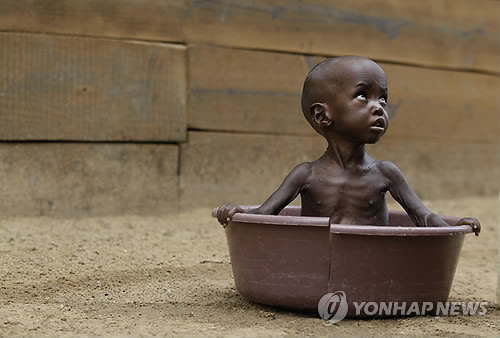
Kenya East Africa Drought"We are possibly seeing a perfect storm in the coming months.... We are going to do everything we can to ameliorate it," UNICEF director Anthony Lake told AFP as he visited Kenya's drought-hit Turkana region.
"We are scaling up in every way we can.... It is very bad now. There will be no major harvests until some time next year. The next six months are going to be very tough," he added.
Turkana is one of Kenya's badly affected regions where malnutrition rates have risen to 37 percent, up from 15 percent in 2010, according to the aid organisation Oxfam.
The drought has also wiped out almost all the cattle, the mainstay of Turkana people, with the remaining emaciated animals driven elsewhere in search of pasture.
"The animals have all died. I am old, I cannot go to town to find work, I cannot fish, so I am just waiting," said 70-year-old Loruman Lobuin, sitting under a tree, his skinny body partly exposed under his traditional shawl.
A nurse in Lodwar, Turkana's main town, said the number of children admitted suffering malnutrition had doubled since last year.
"Many children arrive already malnourished and weak and some are irritable, but they are the lucky ones who make it here."
Lake noted that the drought was not only endangering lives, but "a way of life is being threatened also," referring to the nomadic tradition of the Turkana people.
"I have seen heart-wrenching things and oddly enough, admirable things. I cannot admire enough people living under circumstances like these," said the UNICEF chief after visiting Turkana villages.
Western countries and other donors have pledged millions of dollars in aid for the drought victims but Lake said more still needed to be done.
Britain promised 52 million pounds (59 million euro, 73 million dollars) in emergency aid, in a statement Saturday from International Development Secretary Andrew Mitchell.
"The situation is getting worse and is particularly devastating in Somalia, where families already have to cope with living in one of the most insecure countries in the world," Mitchell said.
He called for doing "more to help not only refugees but also those victims of the drought who remain in Somalia."
UNICEF said last week it needed 31.8 million dollars for the coming three months to assist millions of affected women and children.
It estimates that more than two million children in the region are malnourished and need urgent help, while some 500,000 of them face imminent, life-threatening conditions.
Experts have called for long-term measures to deal with the effects of recurring drought, arguing that the resultant human suffering can be avoided.
"Although governments and their development partners cannot make the rains come, they can mitigate the impact of these recurring droughts in East Africa," Kevin Cleaver of the International Fund for Agricultural Development said this week.
He argued that governments and donors should invest more in agricultural research to develop drought resistant crops and fodder for livestock.
The regions in the Horn of Africa often affected by cyclical drought have also been neglected by governments, with no electricity, roads, water and other basic health and education facilities.
These arid regions, many of them far removed from capitals, have also seen frequent inter-clan clashes over scarce resources as well insurgencies.

Thursday, 14 July 2011

Massive underwater volcanoes found in the Atlantic

British volcanologists have found an unexplored chain of 12 huge, active submarine volcanoes in the icy waters of the Southern Ocean.

Several of the underwater volcanoes measure about 3km high and are dotted over an area the length of Britain, according to scientists from the British Antarctic Survey (BAS).
Underwater volcanoes of the South Sandwich Islands arc. Photo: British Antarctic Survey


That would make them more than three times as high as the world’s tallest building - Dubai's, Burj Khalifa – if on land rather than the sea bed.

Using echo-sounder technology, the research team aboard the RRS James Clark Ross also found 5km diameter craters in the waters around the South Sandwich Islands – 1,500km east of the tip of South America – left by collapsing volcanoes.
Newly discovered volcanoes surrounding Saunders Island in the arc. Photo: British Antarctic Survey

Seven active volcanoes are said to be visible above the sea as a chain of islands, after mapping them at high resolution during two research expeditions.

Talking about the initial discovery  Dr Phil Leat from the BAS said:
“It was amazing to see the images of volcanoes rising up appearing on the screens. We didn’t want to go to sleep and all wanted to wake up early. The feeling was really one of excitement as we never knew what we were going to find next.”

He added that the conical-shaped volcanoes strongly suggest signs of recent eruption, with one eruption forming the chain of seven islands about fifty years ago. 

Although submarine eruptions can cause tsunamis, the risk of disruption to world coastlines is low due to their remote location.

Sunday, 10 July 2011

Mass celebration and hours of formal pomp and ceremony have marked the birth of the world's newest nation.
South Sudan became the 196th sovereign nation after a violent half century as part of Sudan.
Thousands of South Sudanese danced in the streets to mark their long-awaited independence, a hard-won separation from the north that also plunged the fractured region into a new period of uncertainty.
"Free at last," said Simon Agany, 34, as he walked around shaking hands. "Coming away from the north is total freedom."
Men and women coming out of a late night church service shook hands and congratulated each other, wishing each other "Happy Birthday, Happy Birthday."
Among the revellers was South Sudan's information minister, Barnaba Marial Benjamin, who said: "It is already the ninth so we are independent. It is now."
More than 2 million people are said to have died in the decades of civil war between north and south, which formally came to an end with a comprehensive peace agreement in 2005.
Since then, the South has been working towards today's declaration of independence.
Dignitaries from across the world, including the UK Foreign Secretary William Hague and the former US secretary of state Colin Powell are in the South's capital Juba to attend the independence ceremony.
Mr Hague told Sky News the UK would provide £90m in aid to fund the new country's health and education systems but warned the country begins life at a "fragile and dangerous time."
There is no official boundary between north and south because the two sides can't agree where it should be.
Currently, UN peacekeeping troops are patrolling the border town of Abyei after northern soldiers raided it several weeks ago causing more than 100,000 southerners to flee.
There is also no deal between the north and south on how to divide up the lucrative oil revenues, which both depend on for income.
Most of the oil is located in what is now South Sudan, but the pipeline to the only port and many of the refineries are in the north.
Closer to home, the new country's administration is under pressure from a number of armed factions who want a bigger say in how the country moves forward.
On top of all those issues this country has been stalled developmentally because of the wars. It means the infrastructure is all but non-existent.
The vast majority of its people are illiterate because education is rudimentary.
It is said that a girl in South Sudan is more likely to die in childbirth than complete primary school.
It is against this background that the world's newest nation takes its first steps as a free state.